
WELCOME BONUS 300%
UP TO €2000 + 100
FREE SPINS
UP TO €2000 + 100
FREE SPINS
Home → Blackjack
Blackjack at Zeppelin Casino: Variants, Rules and Payouts
Soft 17: Does the Dealer Hit or Stand?
A dealer who hits soft 17 lowers the player's return by 0.22 percentage points, a rule effect that applies to every hand dealt under that rule set. That single rule change is worth more than resplitting aces, which returns 0.08 percentage points, or doubling after a split, which returns about 0.14 percentage points. On €100 of stakes, the hitting rule costs the player roughly €0.22 more per round than a stand-on-soft-17 table.
The most player-friendly rule set combines standing on soft 17 with doubling after a split, resplitting and late surrender, giving an RTP of 99.72% and a house edge of 0.28%. By contrast, six decks with S17, DAS, DOA and a 3:2 payout reach 99.54% and 0.46%. The gap of 0.18 percentage points means €100 staked costs €0.28 on the liberal version against €0.46 on the standard one.
Six decks instead of eight shifts the house edge by about 0.02 percentage points, while a single deck compared with eight decks is worth about 0.48 percentage points. The classic single-deck game pays 3:2 and returns 99.85% with a house edge of 0.15%. That edge is often erased when a table pays 6:5 instead, a change that adds exactly 1.39 percentage points to the casino's take.
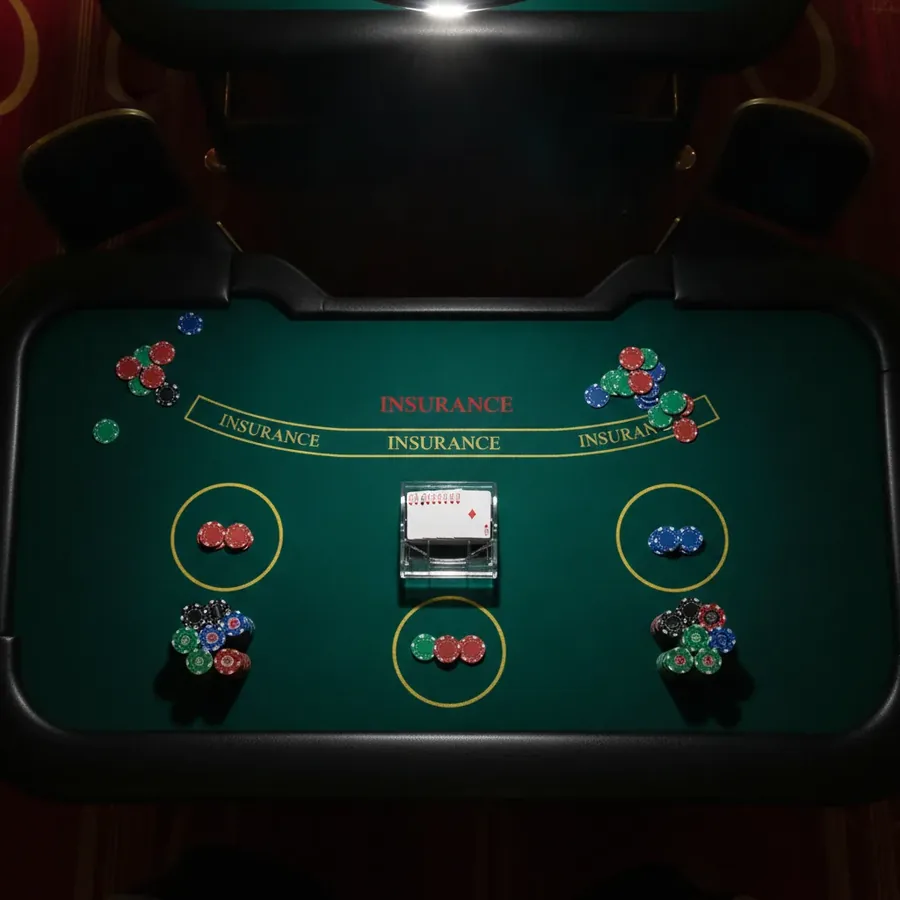
When Can You Raise Your Bet?
Doubling down is allowed on any first two cards in the six-deck S17, DAS, DOA, 3:2 game, and it doubles the stake in exchange for one additional card. Doubling after a split improves the return by about 0.14 percentage points, which is nearly twice the 0.08 percentage points gained from resplitting aces. On a €10 base bet, a double puts €20 at risk on that hand.
Splitting turns one hand into up to four hands, and split aces usually receive one card each. The rule set that allows resplitting, doubling after a split and late surrender reaches an RTP of 99.72% and a house edge of 0.28%. A player who doubles and splits across €100 of total stakes therefore faces an average cost of €0.28 under those rules.
Insurance is a separate side bet of up to 50% of the main bet, taken when the dealer shows an ace, and it pays 2:1. Its RTP is 92.53% with a house edge of 7.47%, far below the 99.54% of the main game. Basic strategy always declines insurance, and on a €10 main bet the maximum €5 insurance stake carries an average loss of about €0.37.
What the Peek Means When the Dealer Shows an Ace
A dealer ace triggers a peek, and if the dealer holds blackjack the hand ends before the player acts further. Late surrender can only be used after that check, and it returns half the stake while improving the return by about 0.08 percentage points. Giving up a €10 hand therefore costs €5, not the full stake.
Insurance is offered when the dealer shows an ace, covers up to 50% of the main bet and pays 2:1. With six to eight decks its RTP is 92.53% and its house edge is 7.47%; on a single deck the edge is about 5.88%. A €5 insurance bet on a €10 hand returns on average well below the 99.54% of the main six-deck game.
Early surrender is worth much more than the late version, up to 0.6 percentage points, but it is extremely rare. The liberal Vegas Strip rule set, which includes late surrender, reaches 99.72% RTP and a 0.28% house edge with a standard deviation of 1.15. For every €100 wagered there, the average cost is €0.28.
Split Aces: Only One Card per Hand
Splitting aces normally gives one card to each hand, and resplitting aces improves the return by 0.08 percentage points. That gain is smaller than the 0.14 percentage points from doubling after a split, but it applies whenever a second ace arrives. A player who splits a pair of aces at €10 per hand commits €20 across two hands.
Splitting is permitted up to four hands in the standard rule set, while split aces are limited to a single card each. The liberal Vegas Strip rules combine resplitting with doubling after a split and late surrender to reach 99.72% RTP and a 0.28% house edge. Doubling after a split alone accounts for about 0.14 percentage points of that return.
A six-deck game with S17, DAS, DOA and a 3:2 payout returns 99.54% with a 0.46% house edge, and that figure requires basic strategy. Replacing the 3:2 payout with 6:5 pushes the house edge to 1.85% and drops the RTP to 98.15%. On a €10 bet, a blackjack then pays €12 instead of €15.
Place Side Bets Before the Cards Are Dealt
Insurance is a side bet of up to 50% of the main bet, placed when the dealer shows an ace, and it pays 2:1. Its RTP of 92.53% and house edge of 7.47% compare poorly with the 99.54% return of the six-deck main game. A €5 insurance stake on a €10 hand gives up roughly €0.37 on average.
Infinite Blackjack from Evolution carries four side bets: Any Pair, 21+3, Hot 3 and Bust It, with bets from €1 to €5,000 and an RTP of 99.47%. Quantum Blackjack Plus Live from Playtech runs from €1 to €5,000 with multipliers up to 1,000x on three-card combinations of 21 points at 99.57% RTP.
A 3:2 blackjack payout pays €150 on a €100 stake, while 6:5 pays only €120, a difference of €30 on the same hand. The 6:5 rule alone adds exactly 1.39 percentage points to the casino's edge, taking the RTP from 99.54% down to 98.15%. Side bets and payout changes both reduce the return over a long run of hands.
Blackjack variants at a glance
| Variant | Payout | House edge | Rule | RTP |
|---|---|---|---|---|
| Blackjack Liberal Vegas Strip (liberal rules, 3:2) | Blackjack 3:2, win 1:1 | 0.28% | The most player-friendly rule set: S17 + DAS + resplit + late surrender. Standard deviation 1.15 | 99.72% |
| Blackjack 6 decks, S17, DAS, DOA, 3:2 payout, basic strategy | Blackjack 3:2, regular win 1:1, insurance 2:1 | 0.46% | Dealer stands on soft 17; double down on any first two cards; doubling after a split allowed; no surrender. Basic strategy is required to reach this figure | 99.54% |
| Blackjack 6:5 payout instead of 3:2 (6 decks) | Blackjack 6:5, win 1:1 | 1.85% | Replacing 3:2 with 6:5 adds exactly +1.39 percentage points to the casino's edge – more than any other rule change. On a €10 bet a blackjack pays €12 instead of €15. | 98.15% |
| Blackjack Split / double / H17 – rule effects | Double – stake ×2 with one card; split – up to 4 hands; split aces usually get one card each. | H17 +0.22 percentage points; RSA −0.08 percentage points; DAS −0.14 percentage points | Dealer hitting soft 17 lowers RTP by 0.22 percentage points; resplitting aces improves it by 0.08 percentage points; doubling after a split improves it by about 0.14 percentage points; 6 decks instead of 8 – about 0.02 percentage points. | n/a (rule modifiers) |
| Blackjack Surrender (late surrender) – rule effect | 50% of the stake returned | −0.08 percentage points | The player gives up the hand after the dealer has checked for blackjack and loses half the stake. Improves RTP by about 0.08 percentage points. Early surrender is worth much more (up to −0.6 percentage points) but is extremely rare. | n/a (rule modifier) |
| Blackjack Single deck, classic rules, 3:2 | Blackjack 3:2, win 1:1 | 0.15% | Fewer decks = lower edge; one deck gives about −0.48 percentage points compared with 8 decks. Often offset by a 6:5 payout. | 99.85% |
Ignoring the Basic Strategy Chart: 1 Percent Wasted
Basic strategy is the condition attached to the 99.54% RTP on the six-deck Blackjack table with S17, DAS, DOA and a 3:2 payout, where the house edge is 0.46%. That figure assumes the player follows the chart on every hand; a blackjack pays 3:2, a regular win pays 1:1 and insurance pays 2:1. Deviating from the chart, even on a single borderline decision, moves the return away from 99.54% and toward a noticeably lower figure.
The size of the deviation depends on the rule set. On the single-deck game with classic rules and a 3:2 payout, the RTP is 99.85% and the house edge is 0.15%, which means fewer decks already give about 0.48 percentage points compared with eight decks. A player who ignores the chart on that table gives back part of that 0.48-point cushion, because the 99.85% figure is calculated for correct play at every decision point.
The most expensive single substitution is replacing 3:2 with a 6:5 payout, which adds exactly 1.39 percentage points to the casino's edge and turns a 10 EUR blackjack from 15 EUR into 12 EUR. The 6:5 table has an RTP of 98.15% and a house edge of 1.85%, so 100 EUR of stakes costs 1.85 EUR on average instead of 0.46 EUR. Ignoring the chart compounds that gap hand after hand.
Side Bets Raise the House Edge to 5%
Insurance is a separate side bet of up to 50% of the main bet, offered when the dealer shows an ace, and it pays 2:1. On a six-deck to eight-deck game the insurance bet has an RTP of 92.53% and a house edge of 7.47%, which is far above the 0.46% edge on the main six-deck Blackjack hand. With a single deck the insurance edge falls to approximately 5.88%, still many times the main-game edge.
Basic strategy always declines insurance except for card counters at a true count of +3 or higher. Staking 100 EUR on insurance at a 7.47% house edge costs 7.47 EUR on average per 100 EUR wagered, whereas the same 100 EUR on the main hand at 0.46% costs only 0.46 EUR. On the single-deck game the insurance cost drops to about 5.88 EUR per 100 EUR, which is still roughly 39 times the main-game edge of 0.15%.
Infinite Blackjack from Evolution carries four side bets named Any Pair, 21+3, Hot 3 and Bust It, with a bet range of 1 EUR to 5,000 EUR and an RTP of 99.47%. Quantum Blackjack Plus Live from Playtech offers quantum multipliers up to 1,000x on three-card combinations worth 21 points, with an RTP of 99.57% under optimal strategy. Each added side bet pulls the blended return below the headline figure.
16 vs 10 played incorrectly: most common error
A hard 16 against a dealer 10 is the hand where basic strategy most often gets ignored, and the cost is measured against the 99.54% RTP on the six-deck Blackjack table with S17, DAS, DOA and a 3:2 payout. That table carries a house edge of 0.46%, but only when every decision follows the chart. Standing on 16 against a 10 instead of hitting raises the effective edge well above 0.46%, because the hand occurs often enough to matter across a session.
The rule effects that surround this decision are measurable. Doubling after a split reduces the house edge by 0.14 percentage points and resplitting aces reduces it by 0.08 percentage points, so a player who misplays 16 against 10 gives back more than either rule is worth. Late surrender, which returns 50% of the stake after the dealer checks for blackjack, improves RTP by about 0.08 percentage points, and on a hard 16 against a 10 surrender is often the chart play.
Blackjack Surrender itself changes the edge by minus 0.08 percentage points, while early surrender is worth up to minus 0.6 percentage points but is extremely rare. On the Liberal Vegas Strip rule set, which combines S17, DAS, resplit and late surrender, the RTP is 99.72% and the house edge is 0.28%. Playing 16 against a 10 incorrectly on that table erases the benefit of the surrender rule in a single session.
Splitting Eights vs Standing on 16
Splitting eights against a dealer 10 turns one weak starting hand into two hands that each begin at 8, and the split itself is capped at up to 4 hands, with split aces usually receiving one card each. Standing on 16 keeps a single hand that loses whenever the dealer makes 17 or better. The split costs one extra stake, so a €10 box becomes €20 at risk on the same round.
Doubling after a split improves the return by about 0.14 percentage points, which is why a split hand that may be doubled is worth more than a split hand that may not. Resplitting aces adds a further 0.08 percentage points, while six decks instead of eight add roughly 0.02 percentage points. Those three rule modifiers together move the return by about 0.24 percentage points, and none of them applies to a hand that is merely stood on.
On a €10 stake the split puts €20 in play, and a double on each resulting hand would raise that to €40. The house edge on the standard six-deck game with standing on soft 17, doubling on any first two cards, doubling after a split and a 3:2 payout is 0.46%, so €100 of stakes costs €0.46 on average. Surrender is the exception: late surrender returns half the stake and improves the return by about 0.08 percentage points.
What a Natural Blackjack Actually Pays
A natural blackjack pays 3:2 on the liberal Vegas Strip rule set, which returns 99.72% with a house edge of 0.28%, and the same 3:2 payout applies to the six-deck game with standing on soft 17, doubling on any first two cards and doubling after a split at 99.54%. On a €10 bet a 3:2 natural pays €15, a profit of €5 above the stake. A regular win pays 1:1, so the same €10 returns €10.
Blackjack 6:5 replaces that 3:2 payout and adds exactly 1.39 percentage points to the casino's edge, more than any other single rule change. The game returns 98.15% and carries a house edge of 1.85%. On a €10 bet the natural pays €12 instead of €15, so the player gives up €3 on every natural blackjack dealt.
A single-deck game with classic rules and a 3:2 payout returns 99.85% and carries a house edge of 0.15%, while one deck against eight is worth about 0.48 percentage points. That advantage is often offset by the 6:5 payout. Between the two extremes, €100 of stakes costs €0.15 on the single-deck game and €1.85 on the 6:5 game, a difference of €1.70 per €100 wagered.
Even Money only possible with Dealer Ace
Even money is offered when the dealer shows an ace, which is the same trigger that opens insurance for up to 50% of the main bet. Insurance returns 92.53% and carries a house edge of 7.47%, and basic strategy always declines it, except for card counters at a true count of at least +3. A €10 main bet therefore allows a €5 insurance stake.
Taking even money on a natural blackjack pays 1:1 instead of 3:2, so a €10 bet returns €10 rather than €15. The six-deck game with standing on soft 17, doubling on any first two cards and doubling after a split pays 3:2 and returns 99.54% with a house edge of 0.46%. Declining the offer keeps the natural live at the full 3:2 rate.
On a single deck the insurance edge is roughly 5.88% rather than 7.47%, which still exceeds the 0.46% charged on the main bet through the six-deck game. Insurance pays 2:1 when the dealer holds a ten underneath. A €5 insurance stake costs about €0.37 on average on a single deck, against a house edge of 0.28% on the liberal Vegas Strip rule set that returns 99.72%.
Continuous Shuffling Machines Reshuffle After Every Round
A continuous shuffling machine returns the discards to the shoe after each round, so the deck composition never drifts far from a full pack across the session. The single-deck game with classic rules and a 3:2 payout returns 99.85% and carries a house edge of 0.15%, while one deck against eight is worth about 0.48 percentage points. Fewer decks mean a lower edge for the player.
Card counting depends on tracking a deck that thins out between shuffles, and the insurance decision at a true count of at least +3 is the one place basic strategy changes. Insurance returns 92.53% and carries a house edge of 7.47%. When the machine reshuffles after every round, the running count resets constantly and the true count rarely reaches that threshold.
Blackjack 6:5, played with six decks, returns 98.15% and carries a house edge of 1.85%, so the 6:5 payout costs exactly 1.39 percentage points against 3:2 and dwarfs any counting gain a player might protect. On a €10 bet the natural pays €12 instead of €15. On €100 of stakes the 6:5 game costs €1.85 against €0.15 on the single-deck classic game.
Contact
Live - online chat
Banking









Providers












Zeppelin Casino 2026